








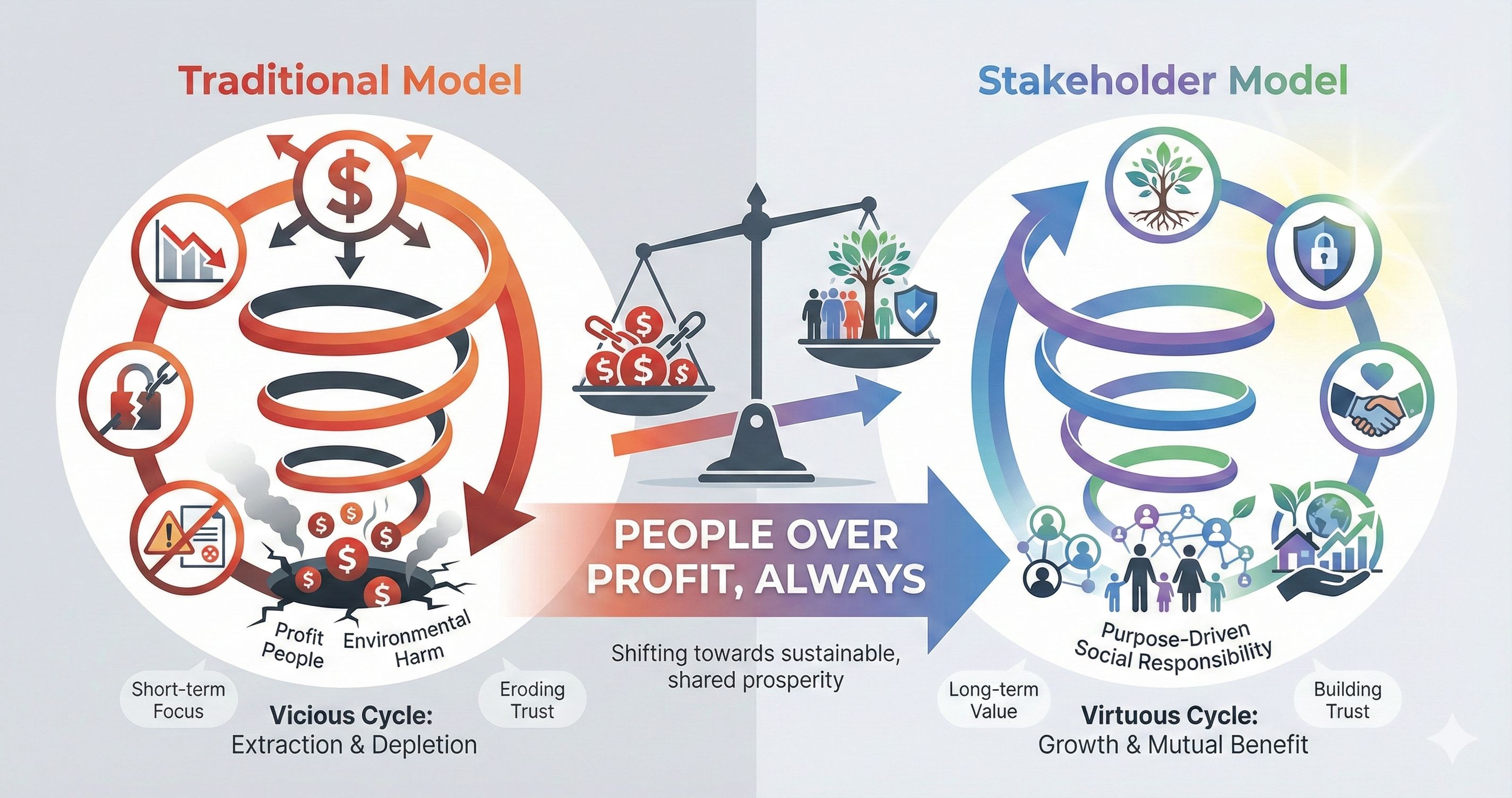
Introduction: a different philosophy
Most companies are graded on three things: revenue growth, profit margins, and shareholder returns. Optimise for those alone and the bill comes due elsewhere — in burnout, in churn, in the trust you spent to make the quarter.
SocialScoreKeeper was founded on a fundamentally different premise: that businesses can—and should—create genuine value for all stakeholders whilst remaining financially successful. This is not altruism; it is strategic alignment of incentives that produces superior long-term outcomes.
There is one critical test running through everything that follows: purpose has to be structurally embedded in the business model, not asserted in marketing copy. The same research that documents the advantages of stakeholder capitalism also documents the failure mode—'purpose-washing'—when companies claim a mission whilst continuing to extract value. SocialScoreKeeper's structure (privacy-first, subscription-only, no advertising) places that test up front rather than as a caveat.
"All you can take with you is that which you've given away."
— Peter Bailey, It's a Wonderful Life
The paradox of profit
Why, for companies solving real human problems, chasing profit directly yields less of it
A recurring argument in business and management research is what is sometimes called the 'paradox of profit': companies that explicitly prioritise profit over purpose often underperform, over the long run, those with stakeholder-focused missions—on the very metric they optimise for, profitability.
Consider one widely cited illustration. In 'Firms of Endearment,' researchers Raj Sisodia, David Wolfe, and Jagdish Sheth tracked a set of companies built around stakeholder value and reported returns of roughly 1,681% over 15 years, against 118% for the S&P 500. The methodology has real limits—the companies were chosen retrospectively as 'endearing,' so survivorship and selection effects inflate the headline figure—but even discounted heavily, a gap that large is hard to square with the idea that purpose and profit are fundamentally in tension.
Plenty of extractive companies are enormously profitable—the claim here is narrower. For businesses whose success depends on customer trust, profit arrives as a byproduct of creating genuine value, and chasing it directly undermines the trust that produces it. Companies that solve real problems create sustainable customer relationships; those that extract value create adversarial dynamics and invite eventual backlash.
Evidence across industries
- Publix: Publix is employee-owned — the people who work there hold the company — and it consistently ranks among the top US supermarkets for customer satisfaction. Studies of employee-owned firms generally find they hold their own or better on productivity and profitability.
- Vanguard: Vanguard is owned by its own funds—which are themselves owned by the investors in them—so it answers to its customers rather than to outside shareholders. It returns the resulting savings as lower fees, and has grown into one of the world's largest asset managers.
- Counterexample: Extraction-based models have produced short-term gains for some platforms but face existential regulatory threats, brand erosion, and declining trust—all of which represent long-term value destruction.
Trust economics and information asymmetry
Why privacy-first business models solve the market failure of social media
Nobel Prize winner George Akerlof's 'Market for Lemons' theory demonstrates that markets collapse when information asymmetry destroys trust between buyers and sellers. In the digital age, this manifests acutely in the relationship between users and advert-supported platforms.
Parents understand—implicitly or explicitly—that major advertising-based platforms profit from data harvesting and attention manipulation. This knowledge poisons the relationship: users know the platform's incentives are adversarial to their wellbeing. The result is declining trust, increasing regulation, and user exodus when alternatives emerge.
SocialScoreKeeper's privacy-first, subscription-based model eliminates this information asymmetry. Our success requires families to renew subscriptions, which requires genuine value creation. There is no hidden extraction; incentives are transparently aligned.
The trust advantage
When customers trust that your success depends on their success, they become advocates rather than sceptics. More of them arrive by word of mouth, which lowers what we spend to find the next family — though it never drops to zero. Here, trust isn't a soft benefit; it's the only acquisition channel we've chosen to build.
Why stakeholder capitalism tends to outperform
The scientific research backing purpose-driven business models
The evidence supporting stakeholder capitalism spans multiple disciplines: economics, organisational psychology, neuroscience, and business management.
Key research findings
Employee Retention
Finding: Deloitte links a strong sense of purpose to better employee retention, and Gallup finds highly engaged teams turn over far less often
Impact: Reduced recruiting and training costs; accumulated institutional knowledge; higher productivity
Customer Lifetime Value
Finding: Forrester's CX Index links a stronger customer experience to greater loyalty, higher lifetime value, and lower churn
Impact: Lower customer acquisition costs; predictable revenue; resilience to competitive pressure
Innovation Performance
Finding: Employees emotionally invested in company mission produce superior innovation outcomes
Impact: Product-market fit; authentic problem-solving; sustainable competitive advantages
Crisis Resilience
Finding: High-trust companies recover faster from adverse events
Impact: Customer loyalty during disruptions; community support; regulatory goodwill
These advantages compound over time. A company built on stakeholder value creates reinforcing loops: loyal customers recruit new customers, engaged employees drive innovation, and authentic mission attracts top talent. The result is sustainable competitive advantage that cannot be replicated through capital alone.
The psychology of purpose-driven work
Why mission, not just money, drives human motivation
Decades of research on human motivation point in a consistent direction: meaning is a durable driver of sustained effort, not merely a soft one. Self-determination theory finds that people are most engaged when their work satisfies a sense of purpose and autonomy, not compensation alone. When individuals believe their work contributes to something larger than themselves, they tend to report higher engagement, persistence, and satisfaction.
This has profound implications for organisational performance. Teams working on missions they believe in:
- Work longer hours without experiencing burnout
- Exhibit higher creativity and problem-solving capability
- Demonstrate greater resilience in the face of setbacks
- Collaborate more effectively with colleagues
- Remain loyal during difficult organisational periods
For SocialScoreKeeper, that means the people building it have kids in these stands too. That shows up in the work, in ways a hired-gun shop rarely matches.
The authenticity requirement
Purpose-washing—claiming social mission whilst maintaining extractive practices—not only fails to produce these benefits but actively backfires. Employees and customers can detect inauthenticity, which breeds cynicism and distrust. Purpose must be structurally embedded in the business model, not merely marketing language.
The anti-social media moat
How choosing values over extraction creates defensible competitive advantages
SocialScoreKeeper's 'anti-social media' positioning creates a structural competitive moat that incumbents cannot cross without destroying their business models.
Defensive advantages
Major advertising-dependent platforms cannot copy SocialScoreKeeper's privacy-first approach without cannibalising their revenue models. Their entire infrastructure—data harvesting, algorithmic curation, attention maximization—is structurally opposed to user wellbeing. Any authentic privacy commitment would mean abandoning advertising itself—the model that produces the vast majority of revenue at Meta and every other major ad-funded platform.
Result: They are locked into extraction models even as trust erodes and regulation tightens.
Offensive advantages
Every Cambridge Analytica scandal, every whistleblower testimony about teen mental health harms, every privacy breach strengthens SocialScoreKeeper's positioning. We do not need to attack competitors—their own business models generate the marketing for us.
Result: Regulatory pressure and cultural backlash become tailwinds rather than headwinds.
This is the essence of strategic positioning: we have chosen a market position that aligns economic success with customer wellbeing. Competitors face a tragic choice between short-term profits and long-term sustainability; we face a different constraint, and honesty requires naming it: with no advertising and no data sales, we have no fallback revenue—subscription renewal is our only engine, which is precisely why we cannot afford to stop earning trust. The moat and the constraint are the same wall, and we built it deliberately.
Subscription economics vs. advertising economics
Why aligned incentives produce superior unit economics
Economic model comparison
Advertising Model
Revenue:
Paid by advertisers, not by you
Incentive:
Maximise engagement (addiction) regardless of user wellbeing
CAC:
Rising customer acquisition costs due to privacy regulations and declining trust
Churn:
High implicit churn as users reduce usage or switch platforms
Regulation:
Facing antitrust action, advertising restrictions, privacy mandates
LTV:
Declining as regulations limit data harvesting and users become sophisticated
Subscription Model (SocialScoreKeeper)
Revenue:
About $100/year, paid by the family it serves
Incentive:
Keep families happy so they renew—success requires value creation
CAC:
Falling customer acquisition costs as word-of-mouth compounds
Churn:
Low churn when customer success equals company success
Regulation:
COPPA-compliant by design; privacy regulations create competitive advantage
LTV:
Grows as children age — and, over time, as we expand beyond athletics into other activities families care about
The subscription model creates a virtuous cycle: satisfied customers renew and recruit others; improving unit economics fund product development; better product creates more value; and increased value supports pricing power. The advertising model creates a vicious cycle: extractive practices erode trust; declining trust requires increased advert spending; higher costs pressure further extraction; and extraction accelerates user departure.
What you give away: the economics of legacy
Why Peter Bailey's wisdom is sound business strategy
The character Peter Bailey's insight—'All you can take with you is that which you've given away'—is not merely philosophical wisdom. It describes the mechanics of network effects and brand equity in stakeholder capitalism.
What we 'give away'
- Privacy protection—no data harvesting or surveillance capitalism
- Family connection—solving sharenting anxiety and communication overload
- Time back to parents—automation of logistics and simplified sharing
- Child safety—COPPA compliance and adults-only account creation
- Data ownership—families control their content, not us
What we 'take with us'
- Word-of-mouth advocacy — most US parents are uneasy about how social platforms collect data on children (Pew Research), and their values map directly to ours
- Brand loyalty—protecting children creates the deepest possible customer bond
- Organisational legacy—building something that strengthens families creates meaning beyond revenue
- Talent attraction—mission-driven work attracts exceptional people who could earn more elsewhere
- Economic resilience—purpose creates patience and forgiveness during inevitable missteps
This is the paradox at the heart of stakeholder capitalism: by explicitly optimising for stakeholder value rather than shareholder value, we create deeper, more defensible, more valuable shareholder returns in the long term. The companies that 'give away' the most—in the form of genuine value creation—accumulate the most durable competitive advantages.
Conclusion: the strategic case for stakeholder capitalism
Why doing good and doing well are the same thing for companies solving human problems
The business philosophy underlying SocialScoreKeeper is not altruism masquerading as strategy. It is strategy informed by economics, psychology, and organisational science.
For companies that build products to solve human problems — rather than exploit human weaknesses — stakeholder capitalism tends to win where it counts:
- Word of mouth lowers what it costs to find the next family.
- Loyal customers stay longer and are worth more.
- Privacy regulation becomes a tailwind, not a threat.
- Trust deepens the brand instead of exposure eroding it.
Major platforms built on shareholder primacy and extraction achieved scale—but at enormous negative externalities that society is beginning to price in through regulation, litigation, and cultural rejection. They represent 20th-century capitalism: extract maximum value, externalise costs, optimise for quarterly earnings.
SocialScoreKeeper represents 21st-century capitalism: create genuine value, internalise alignment, optimise for sustainable relationships. This is not a tradeoff between profit and purpose—it is a recognition that profit and purpose are inextricably linked for companies whose success depends on solving real problems.
"In a market built on trust, the only durable strategy is to be worth trusting."
— SocialScoreKeeper
SocialScoreKeeper exists because we believe families deserve technology that serves them rather than surveils them. Our business model reflects that belief—and the economic evidence suggests it will serve us well.
Selected references and further reading
The arguments presented in this document draw on research from multiple disciplines. Key sources include:
- Akerlof, G. A. (1970). 'The Market for Lemons: Quality Uncertainty and the Market Mechanism.' Quarterly Journal of Economics.
- Edelman Trust Barometer (Annual). Global survey of trust in institutions, including technology companies.
- Friedman, M. (1970). 'A Friedman Doctrine: The Social Responsibility of Business Is to Increase Its Profits.' The New York Times Magazine.
- Kanter, R. M. (2011). 'How Great Companies Think Differently.' Harvard Business Review.
- Sisodia, R., Wolfe, D., & Sheth, J. (2014). Firms of Endearment: How World-Class Companies Profit from Passion and Purpose (2nd ed.). Pearson FT Press.
- Forrester Research. Customer Experience Index — annual study of customer loyalty, lifetime value, and brand purpose.
- Deloitte Insights. 'The Power of Purpose' — research on purpose-driven workforce retention and performance.
- Gallup. 'To Get Your People's Best Performance, Start With Purpose' — workplace engagement and turnover research.
- Pew Research Center. Surveys on parental concern about social media data collection on children.
- Mackey, J., & Sisodia, R. (2013). Conscious Capitalism: Liberating the Heroic Spirit of Business. Harvard Business Review Press.
- Porter, M. E., & Kramer, M. R. (2011). 'Creating Shared Value.' Harvard Business Review.
- Rock, D. (2009). Your Brain at Work: Strategies for Overcoming Distraction, Regaining Focus, and Working Smarter All Day Long.
- Stout, L. A. (2012). The Shareholder Value Myth: How Putting Shareholders First Harms Investors, Corporations, and the Public. Berrett-Koehler Publishers.
- The Business Roundtable (2019). 'Statement on the Purpose of a Corporation.'
- Zak, P. J. (2017). 'The Neuroscience of Trust.' Harvard Business Review.
Try it free for a month
The business model is the product promise: we only make money if your family keeps using it.
Start Your Free Trial